Which Compound to Use to Manufacture an LED Bulb Housing
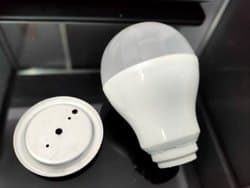
What Is It?
NEXXALITE™ Glass Fiber Reinforced PBT Compound adds 15% to 35% glass fiber to the PBT base, delivering high heat deflection temperature with excellent electrical properties.
How It's Manufactured
Glass fiber is compounded into PBT resin on a twin-screw extruder, with fiber loading selected by grade to balance the heat and dimensional performance a given application needs against moldability at thinner wall sections.
Manufacturing Process for This Application
LED and CFL housings, along with automotive light bezels, are injection molded from the dried, reinforced compound. A housing seated directly around or near an LED or CFL light source runs continuously warm, so mold and part design account for sustained thermal exposure rather than just momentary heat spikes.
Why Polymer Choice Matters Here
A housing that softens or dimensionally drifts under sustained heat from its own light source will eventually loosen its fit around the bulb or driver electronics — PBT's high heat deflection temperature, reinforced further by glass fiber, is chosen specifically to prevent that failure mode over the product's rated lifetime.
Why This Compound Is Suited
The grade's applications explicitly include "Car mirror Cover, LED Housing, CFL Housing, Door Handles, Electrical and electronic spare parts, Automotive electric plug, Automotive light bezel application" — LED housings sit squarely within its intended use.
Nexxa Compounds is a leading manufacturer of PBT compounds for led bulb housing applications in India, supplying some of the largest manufacturers across India and internationally.
Related Posts
Which Compound to Use to Manufacture an Electrical Connector
Why unfilled PBT is a standard choice for electrical connectors and valve components needing tight tolerances.
Which Compound to Use to Manufacture an Industrial Pump Body
Why an impact-modified super tough PBT grade is used for pump bodies and water tap components.
Which Compound to Use to Manufacture a Power Connector
Why flame retardant glass-filled PBT is specified for power connectors, plugs, and terminal blocks.